|
LambLisp 01 Red Fox Alpha
From AI to Actuator
|
|
LambLisp 01 Red Fox Alpha
From AI to Actuator
|
Public Member Functions | |
| virtual size_t | write (uint8_t c)=0 |
| virtual size_t | write (const uint8_t *buf, size_t n) |
| size_t | write (const char *s) |
| size_t | print (char c) |
| size_t | print (const char *s) |
| size_t | print (const String &s) |
| size_t | print (int n, int base=10) |
| size_t | print (long n, int base=10) |
| size_t | print (unsigned long n, int base=10) |
| size_t | print (double v, int digits=2) |
| size_t | println () |
| size_t | println (char c) |
| size_t | println (const char *s) |
| size_t | println (const String &s) |
| size_t | println (int n, int base=10) |
| size_t | println (long n, int base=10) |
| size_t | println (unsigned long n, int base=10) |
| size_t | println (double v, int digits=2) |
| size_t | printf (const char *fmt,...) CHECKPRINTF_pos2 |
MOVED HERE, and it must stay below this point: Print uses String (typedef at typedef LL_String String above) and CHECKPRINTF_pos2 (defined just above). Declared any earlier in this header and the compiler reports "String does not name a type" – which is a header-ordering error, not a missing class.
GUARDED, AND IT MUST BE. On ESP32 the VENDOR Arduino core defines its own Print and Stream (cores/esp32/Print.h, Stream.h) via Arduino.h, so declaring these unconditionally is a "redefinition of class Print" build failure on every ESP32 target. It compiled clean on the hosts because there is no Arduino core there to collide with – which is exactly why the mistake was invisible until an ESP32 build ran. When this block was moved down here to sit below the String typedef it left the LL_ARDUINO guard that ends further up; it now carries its own. LLArduino PROVIDES these where the vendor core is absent, and defers to it where present.
LL_ARDUINO Print / Stream / Serial. NOT STUBS, and they need not be: Print and Stream are pure character I/O, and LambStdio ALREADY implements exactly that on POSIX (stdin/stdout in non-canonical mode). So this is an Arduino-SHAPED FACADE over working I/O, in the same class as millis() – genuinely implemented, not simulated. It is what lets sketch-style code (Serial.println("hi")) run on a host with no board, and on WebAssembly and Windows, where Espressif's core cannot go at all.
FIDELITY IS THE RISK HERE, not capability. Arduino's Print has behaviours worth matching DELIBERATELY rather than by accident, and each is a place a host test could pass while the device disagrees: println() terminates CRLF ("\r\n") not "\n"; write() returns a BYTE COUNT; print(double, digits) defaults to 2 decimal places; print(int, base) supports BIN/OCT/DEC/HEX. Those are exactly what success criterion 3 exists to check – the same suite run against the vendor core and against LLArduino must agree.
|
pure virtual |
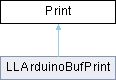
Implemented in LLArduinoBufPrint.